
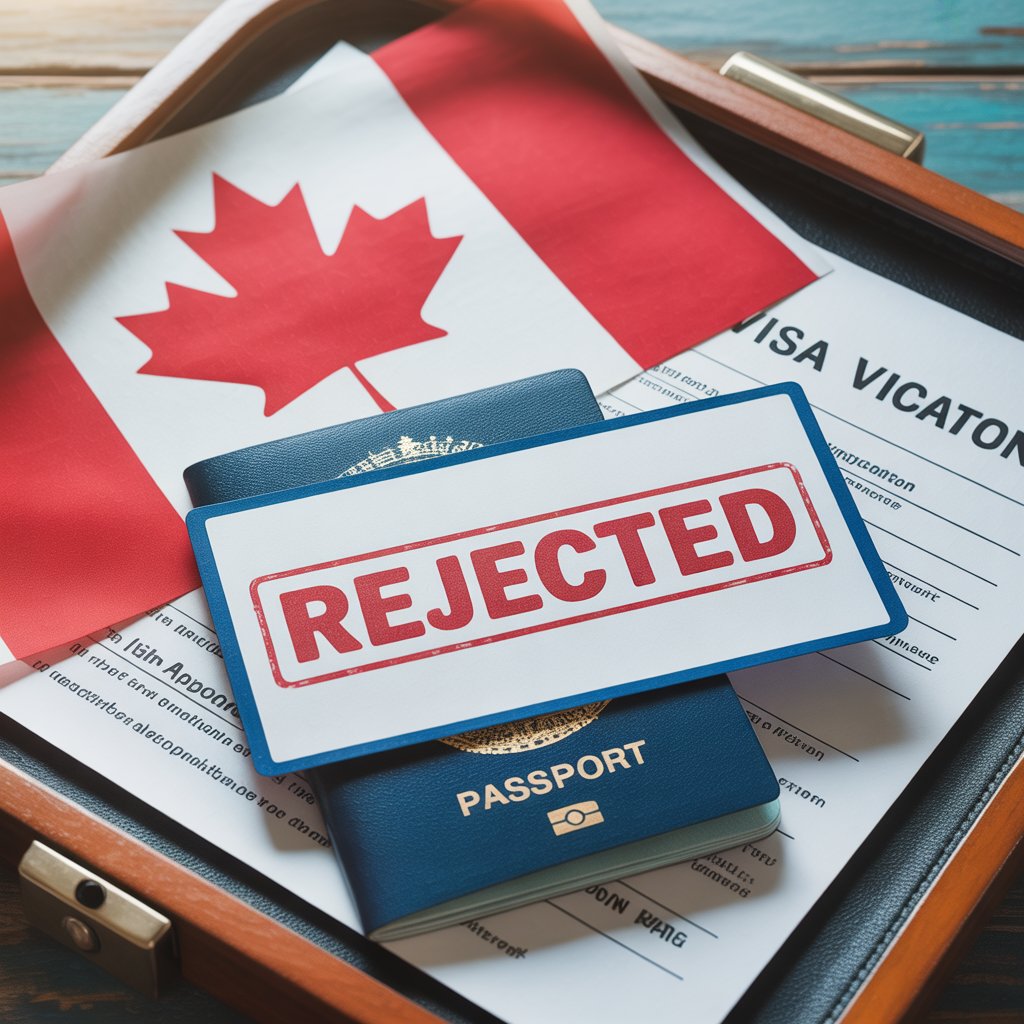
Have you ever wondered why your study visa application for Canada might be rejected? Canada is a popular study destination for Indian students, but in 2025, many applications were denied due to preventable issues that could have been addressed with more careful preparation and knowledge of the requirements. In this article, we will examine the most common reasons for the refusal of a Canadian study permit and outline the steps you can take if your study visa application is denied.
Canada is, of course, one of the top destinations for international students. As previously mentioned, numerous Canadian study abroad applications are rejected for various reasons. Here are some reasons why a study permit for Canada may be refused.
A lack of sufficient funds is one of the primary reasons for the denial of a study permit for Canada. To qualify, you must provide adequate proof that you have enough financial resources to cover your tuition fees and support yourself, as well as any accompanying family members, while you are in Canada. The proof of funds requirement was updated recently in September 2025. Currently, the minimum fund requirement (excluding tuition fees and transportation expenses) for all provinces and territories (except Quebec) is as follows:
- $22,895 if the applicant is applying
- $28,502 if one family member is accompanying the applicant
- The requirement increases with each additional family member.
Additionally, all foreign nationals need to have valid health insurance.
Note: Obtain a Quebec Acceptance Certificate (CAQ) issued by the Ministère de l’Immigration, de la Francisation et de l’Intégration, if you are planning to study in Quebec. In Quebec, you are required to pay a settlement fee of $500 for the first year in Canada, and the financial requirements differ depending on your age and family size.
Read more about Canada family sponsorship programmes.
To successfully obtain a Canada study permit, it is essential to have a clear understanding of the regulations, criteria, and procedures involved. First, we convince the officers by submitting the relevant documents, such as:
The required documents can vary for each individual, and the fund requirements change annually; therefore, it is advisable to consult professionals who can provide accurate guidance. ImmiLaw Global's professional lawyers and consultants will help you to be complete and transparent in submitting your proof of funds.
Misrepresentation is another common reason for the rejection of a student visa to Canada. Misrepresentation occurs when the information you have provided is false, inaccurate, incomplete, or misleading. You must note that mistakes or errors that are unintentional, such as failing to provide past travel history to Canada, can also be considered misrepresentation by the officials.
Submission of false, fraudulent, or altered documentation;, failure to disclose important details, such as criminal records; and providing inconsistent or contradictory details are some of the instances that IRCC classifies as misrepresentations of information.
Along with application refusals, misrepresentation can lead to criminal charges, loss of temporary resident status, and removal from Canada, a lifelong fraud record with the IRCC, and a ban from entering Canada for up to five years.
As a student, you must prove to the officials your genuine intent to visit Canada as a temporary resident. If you fail to persuade the officials that you will depart from Canada once your studies finish, they will reject your study permit. The political and economic situation of your home country is also taken into consideration by the officials, and instability can raise concerns.
The risk of application refusals can be reduced by demonstrating strong ties with your home country. This can be done by showing:
Your application will not be refused due to dual intent (in the future wanting to apply for PR); however, as a student, you have to give a convincing explanation that you will leave Canada after your studies. At ImmiLaw, we will help you prove your intent to obtain temporary resident status in Canada.
Your study permit will get rejected if you do not have a well-defined primary objective, which is to study and get an international qualification. Immigration officers will check whether your objective of studying in Canada is aligned with your past academic and work background and if the chosen program connects with your future goals.
The key points that officers check and how you can clearly articulate the purpose of your visit are given below:
If you are choosing an entirely different program from that of your previous studies, then provide sufficient reasons for it and explain why it is best for your long-term plan.
Provide adequate reasons why the program will benefit you, such as filling a specific skills gap.
Provide valid reasons why the program will enhance your skills, improve your employability, and help you achieve your professional goals.
ImmiLaw will help you develop a well-written SOP that provides valid and convincing motivation for your studies, thereby strengthening your application.
Missing or incomplete documentation is a major reason for rejection of a Canadian study visa. IRCC categorizes the documents as always required, needed in most cases, recommended, or required only in certain situations based on your specific circumstances. Further, once you have paid the study permit fee of $155, you must upload the receipt. If you fail to make the payment or miss uploading the proof of payment, it can lead to processing delays or refusals. IRCC may also request additional documents based on your situation, and to avoid delays or refusals, you must respond quickly and on time.
ImmiLaw professionals can help guide you through the documentation stage so that you don’t miss out on submitting any documents.
Immilaw Global is one of the top immigration consultants in India, providing seamless immigration and study abroad services for candidates seeking international study opportunities or migration to foreign countries. Being one of the best Canadian study visa consultants in India, we help you get through the smooth process of your study permit application.. Our experienced professionals carefully review each profile and recommend the best possible strategy and services to avoid Canada study visa rejection and achieve application success.
Contact Us to get appointment to our Canada immigration consultants.













65be04cbad701.webp)













 CANADA
  +1 (647) 767-0672
 INDIA
INDIA